Cyber Essentials Certification
Protecting your business shouldn't be stressful. SafeWatch is an official, accredited IASME Certifying Body authorized by NCSC to conduct your Cyber Essentials and Cyber Essentials Plus audits and directly issue your official certificate. Deal directly with our Lead Assessor team (07920 151412)—without unhelpful sales reps or call centres—with fast 24–48h turnarounds on Basic assessments.
Official IASME Certifying Body
SafeWatch is an official, licensed IASME Certifying Body authorized by NCSC to perform your technical audit and directly issue your official UK certificate:
- Direct Technical Audit: We audit your firewalls, devices, cloud services, and user access controls.
- Official Certificate Issuance: We perform the audit review and directly sign and issue your official UK NCSC Cyber Essentials certificate.


Continuous Cyber Essentials Compliance Retainer
Stop treating Cyber Essentials as a point-in-time annual rush. Security posture changes whenever you onboard new cloud services, roll out devices, or update firewall rules. SafeWatch offers a 365-day retainer providing continuous access to one of our experienced assessors, 4 quarterly compliance reviews per year, and your complete annual Cyber Essentials audit and certification included.
Our Experienced Assessors
Lead Assessors & Cyber Security Partners
With over 30 years of combined IT infrastructure and governance experience, our lead assessors personally guide local SMEs, science parks, and tech firms through their scoping boundaries.
Based in Banbury, our Lead Assessor team provides direct 1-on-1 auditor guidance (07920 151412) across the UK.
Watch: Cyber Essentials — Implementing the Firewalls Control
Learn how to satisfy the 5 mandatory NCSC v3.3 boundary firewall requirements, cloud security groups, and remote worker router scoping in this 90-second Lead Assessor guide.

Government Commits £90 Million to SME Cyber Security
The UK Government has committed a landmark £90 million funding package to establish Cyber Essentials as the baseline standard for all UK Small & Medium Enterprises (SMEs). This highlights the critical need for securing internet perimeters, enforcing MFA, and training staff. As an accredited certifying body, SafeWatch helps Midlands SMEs prepare for their Cyber Essentials audits and calculate scoping boundaries.
Cyber Essentials Requirements Checklist: The 5 Controls
Use this as your Cyber Essentials checklist. SafeWatch audits organizations against the five core technical requirements specified under the latest NCSC standard:
Boundary Firewalls & Internet Gateways
Enforce strict corporate firewall perimeters to protect all internal network segments, WAN gateways, and subnets. Any open ports or misconfigured router access lists represent immediate vulnerabilities and will result in automatic audit failure.
Secure Configuration
Eliminate security drift by enforcing corporate templates that disable default manufacturer accounts, enforce complex custom logins, shut down unnecessary auto-run properties, and lock down active protocols.
User Access Control & MFA Mandate
Limit administrative accounts exclusively to core needs and enforce least-privilege. Under the Danzell Standard, Multi-Factor Authentication (MFA) must be active across 100% of user and admin logins for cloud services (SaaS/PaaS/IaaS) holding corporate records.
Malware Protection
Protect organizational systems against malicious code. Audits verify that all endpoints run active anti-malware software, utilize application sandboxing, and configure strict code signing to block untrusted applications.
Security Patch Management
Establish strict administrative policies ensuring all operating systems, software packages, and firewalls are patched within 14 days of a critical or high-risk vulnerability release, mitigating zero-day exploits.
Frequently Asked Questions
Practical regulatory insights compiled by our accredited Lead Assessor team regarding UK Cyber Essentials certifications.
How does Cyber Essentials certification work?
Cyber Essentials is a government-backed cyber security certification scheme designed to protect your business against up to 99% of common internet threats. Guided by our accredited IASME Lead Assessor team, SafeWatch provides step-by-step auditing, technical verification, and official certification signing. You can review technical requirements in detail on the official NCSC Cyber Essentials standards, or prepare your answers using the official IASME Cyber Essentials question set.
How does SafeWatch help schools meet DfE Cyber Security Standards?
SafeWatch aligns school and academy trust systems with the UK Department for Education (DfE) Digital Standards. Our accredited Lead Assessor team guides school IT teams through segmenting student subnets, BYOD boundary controls, and achieving official certification.
Do I need Cyber Essentials for UK government tenders?
Yes, under Procurement Policy Note PPN 09/14, any supplier bidding for UK central government contracts that involve handling personal, sensitive, or public data must hold a valid Cyber Essentials certification.
Where can I find the official Cyber Essentials standard?
The official Cyber Essentials requirements and framework standards are published directly by the UK National Cyber Security Centre. You can access the complete overview and download the technical infrastructure guidelines on the official NCSC Cyber Essentials standards page.
Where can I download the Cyber Essentials self-assessment question set?
You can download the latest official Cyber Essentials self-assessment questions for preparation. Simply visit the IASME Cyber Essentials Question Set Download page to retrieve the current requirements document in PDF or Excel formats.

Are you a Midlands MSP? Partner with SafeWatch
Managed Service Providers (MSPs) across Oxfordshire, Warwickshire, and the Midlands partner with SafeWatch to deliver independent compliance checks for their clients. Because we focus 100% on auditing (and do not sell competing IT support or management services), your client relationships remain completely secure. We scope and assess the audits, while you manage the profitable hardware and software remediation upgrades.
Cyber Essentials Audit, Gap Analysis & Pricing Services
SafeWatch is an accredited IASME Certifying Body delivering official UK NCSC Cyber Essentials audit, gap analysis, and vulnerability assessment services. We provide clear, upfront pricing with 24–48 hour fast-track audit turnaround and zero sales call centres.
Cyber Essentials Self-Assessment
SafeWatch reviews, verifies, and signs off on your official NCSC Self-Assessment Questionnaire, providing the foundational digital shield.
- Official IASME Portal Access
- Pre-submission compliance review by our Lead Assessor desk
- Verification & formal NCSC Certification
- £25,000 Free Cyber Insurance Indemnity (for UK micro/small businesses under £5M turnover)
Cyber Essentials Technical Audit
Rigorous physical and logical technical validation audit. SafeWatch assessors actively audit your endpoints and network perimeters to mark you as fully compliant.
Price On Application
POAPricing is customized based on active endpoints, server counts, physical site scope, and teleworking distribution. Click below to generate a tailored scoping estimate.
- All Self-Assessment marking included
- External vulnerability scans by certified SafeWatch auditors
- On-site or remote endpoint configuration checks
- Email delivery & malware prevention testing
- Official Cyber Essentials certification signing
Continuous Cyber Essentials Retainer
Shift from a point-in-time annual rush to 365-day continuous compliance. Maintain continuous posture alignment with our accredited Lead Assessor team.
Annual Retainer Offering
365-DAYIncludes continuous assessor advisory, 4 quarterly compliance reviews, and your full annual Cyber Essentials assessment & certificate sign-off.
- Continuous Assessor Access: Year-round direct access to our accredited Lead Assessor team (07920 151412) for infrastructure changes & scoping advice
- Quarterly Compliance Reviews (4x / Year): Structured quarterly reviews (Q1–Q4) to audit configuration drift, patch SLAs, MFA, & BYOD
- Annual Assessment Included: Full annual audit verification, marking, and official NCSC certificate sign-off included
- Emergency Scoping Guidance: Immediate support when onboarding new SaaS tools, office subnets, or remote teleworkers
- Zero Point-in-Time Stress: Keep your security perimeter audit-ready 365 days a year
Audit Readiness & Training Support
Support courses and ongoing chief advisory retainers to assist internal IT teams in passing the Cyber Essentials audits marked by SafeWatch.
Cyber Essentials Plus Audits & Vulnerability Scanning
Requires independent hands-on technical verification, internal endpoint vulnerability scanning, and email/web payload testing. Mandatory for UK Government (PPN 09/14) & NHS DSPT contracts.
Free £25,000 UK Business Cyber Liability Insurance
UK-domiciled organizations with annual turnover under £20 million automatically receive £25,000 of free commercial cyber insurance coverage upon achieving Cyber Essentials through SafeWatch.
Our 4-Step Audit Process
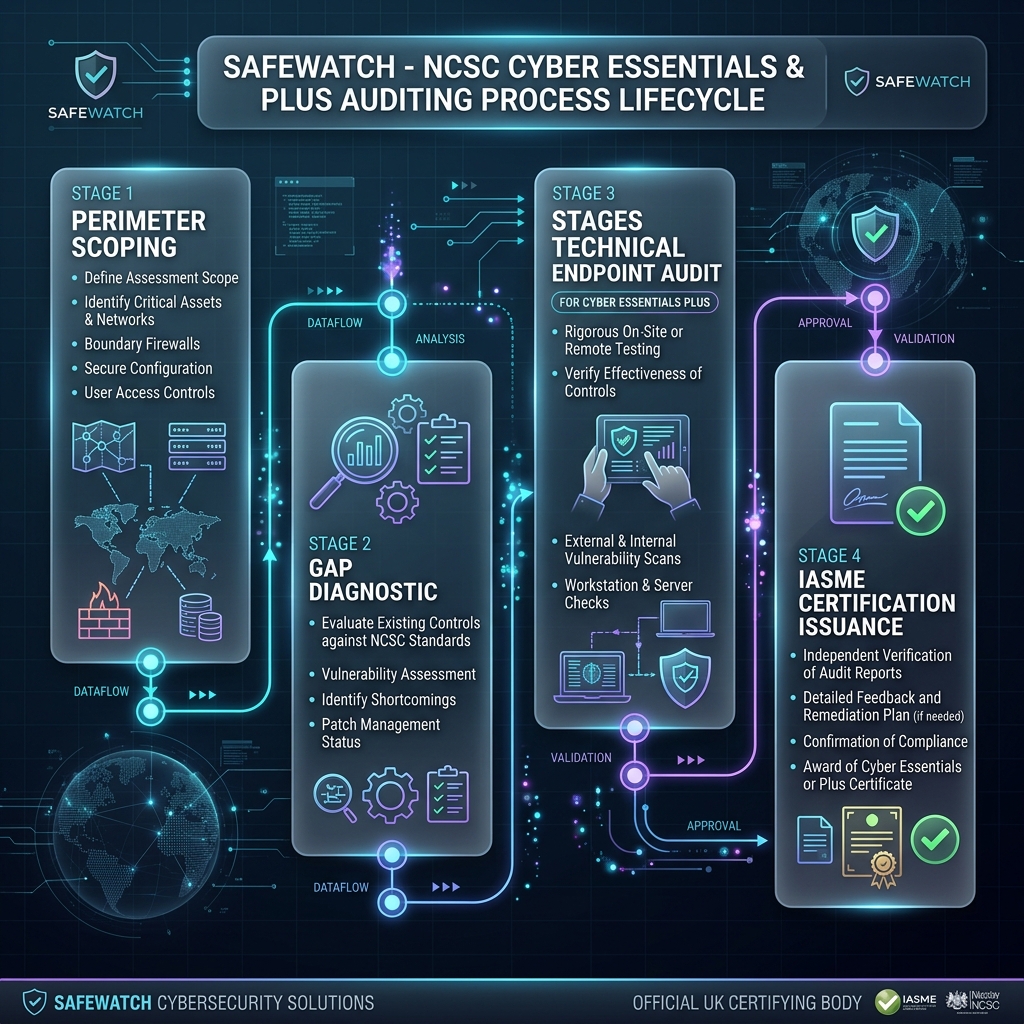
SafeWatch NCSC Auditing Process Lifecycle
SafeWatch assessors guide your business through a structured four-stage regulatory pathway to verify your technical perimeters and award the official IASME Cyber Essentials credentials.
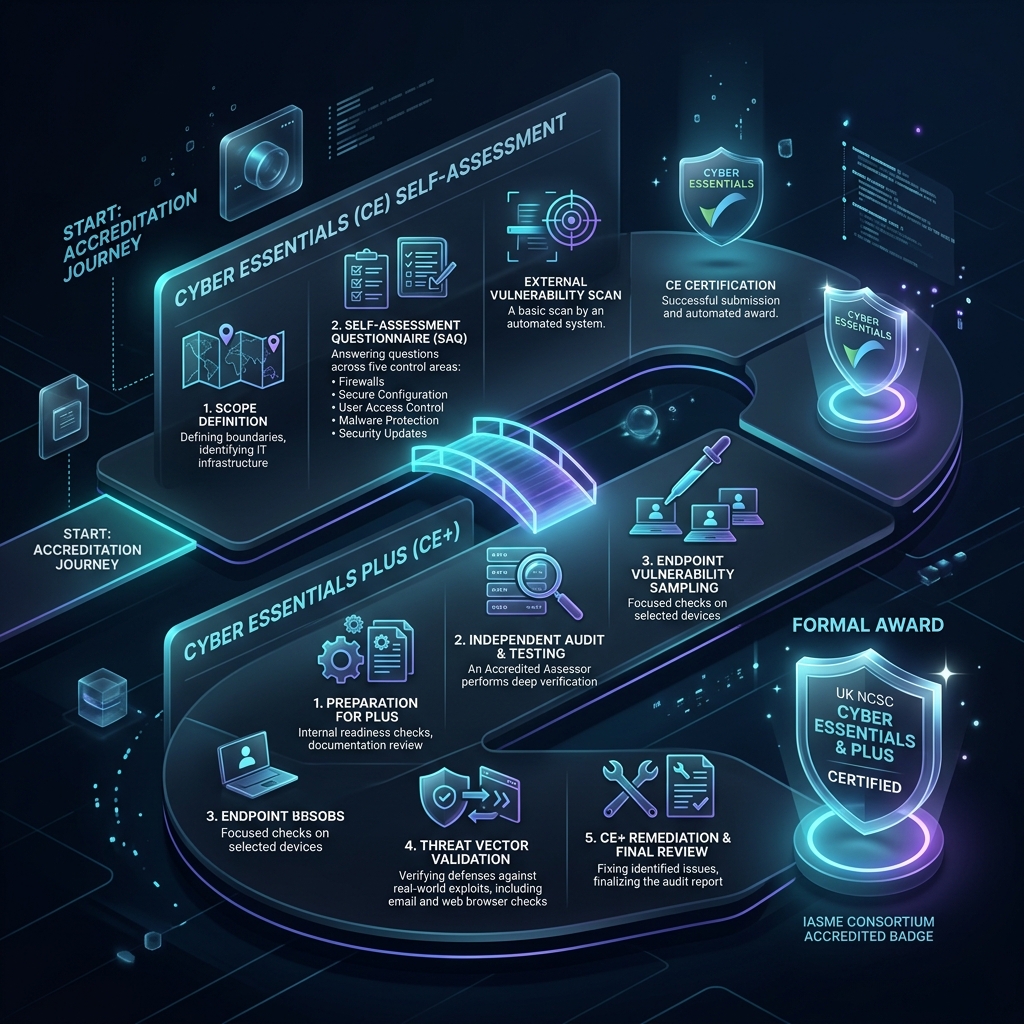
SafeWatch Accredited Compliance Training Pathway
Operational milestone blueprint for corporate administrators and compliance officers tracking certification audits and risk advisory levels.
Tailored Industry Cyber Essentials Auditing
SafeWatch provides specialized Cyber Essentials scoping aligned with the latest NCSC Denzell standard requirements for regulated UK sectors.
⚖️ Legal & Professional Services
Align your solicitors' practice with SRA Code of Conduct requirements and Lexcel risk standards. SafeWatch verifies cloud legal case management tools, MFA boundaries, and GDPR client data protection.
Request Legal Scoping →⚙️ Engineering & Technology SMEs
Satisfy commercial supplier standards, PPN procurement mandates, and enterprise supply chain requirements. Fast-track 24-hour verification by our accredited Lead Assessor team.
Request SME Tender Audit →🏥 Healthcare & NHS Suppliers
Harmonize Cyber Essentials audit evidence with your NHS Data Security and Protection Toolkit (DSPT) submission to secure digital health contracts.
Request Healthcare Scoping →🎓 Schools & Multi-Academy Trusts
Fulfill Department for Education (DfE) Cyber Security Standards. We assist school network administrators with subnet isolation and BYOD filtering policies.
Explore School Audit Hub →The 5 Security Controls of Cyber Essentials
By implementing these five fundamental technical controls, organizations block over 80% of common internet threats. Let's break down how each control keeps you secure and compliant.
Download the 2026 Cyber Essentials 5 Controls Pre-Audit Checklist PDF
Comprehensive step-by-step audit preparation checklist verifying your firewalls, admin accounts, software updates, malware shields, and access policies.
Watch: Cyber Essentials — Implementing the Firewalls Control
Learn the 5 mandatory NCSC v3.3 technical requirements for boundary firewalls, cloud security groups, and remote worker router scoping in this 90-second Lead Assessor guide.
Firewalls & Internet Gateways
Create a secure perimeter barrier between your internal network and the public internet to block unauthorized incoming traffic.
- Change default firewall admin passwords
- Block all unapproved inbound connections
- Ensure outbound rules restrict unsafe destinations
Secure Configuration
Hardening system settings to reduce vulnerability surfaces. Turn off defaults that leave your devices exposed.
- Disable unused ports and auto-run features
- Uninstall unnecessary default programs
- Change all manufacturer default passwords
User Access Control
Enforcing the Principle of Least Privilege. Only grant administration rights to those who absolutely need them.
- Standard users must not have admin privileges
- Restrict software installation rights
- Enforce Multi-Factor Authentication (MFA)
Malware Protection
Keep malicious code from executing. Protect your endpoints from virus, worm, and ransomware infections.
- Deploy active antivirus scanning software
- Enable OS app store verification (sandboxing)
- Block known untrusted browser extensions
Patch Management
Closing known security backdoors. Keep all operating systems and software updated to block active exploits.
- Install critical updates within 14 days of release
- Remove out-of-support legacy applications
Are Your Controls Ready for Audit?
Take our interactive Gap Diagnostic to check your compliance status across all 5 controls in under 5 minutes.
Cyber Essentials Firewall Requirements & Boundary Gateways
Detailed technical criteria and step-by-step checklist to satisfy the Cyber Essentials firewall requirements under NCSC standards v3.3.
Watch & Listen: Explaining Boundary Firewalls under NCSC v3.3
Interactive video script & audio overview breaks down default admin passwords, port blocking, cloud security groups, and remote router rules.
What is a Boundary Firewall?
A boundary firewall is your network's first line of defense. It acts as a digital security guard, sitting between your private local area network (LAN) and the public internet. It monitors all incoming and outgoing data packets and decides whether to allow them through based on a set of strict rules.
For remote workers, the "boundary" shifts to their home routers. Cyber Essentials requires these gateway routers to be secured, or protected via local host-based firewalls on the operating system of their business devices.
Cloud Boundary Firewalls (AWS & Azure) & Remote Worker Router Scoping
☁️ Cloud Firewalls (AWS Security Groups / Azure NSGs)
Cloud infrastructure hosting company data (AWS VPCs, Azure VNets, Google Cloud Compute) fall directly inside your audit scope. Security Groups must restrict inbound access, disabling default 0.0.0.0/0 ingress for management ports (RDP 3389, SSH 22).
🏠 Remote & Hybrid Worker Router Rules
Home routers used by employees working remotely must have default ISP admin passwords changed, remote WAN management disabled, and software firewalls enabled on all corporate laptops.
Why Googlebot & Auditors Care
Vulnerability scanners automatically target public-facing IP addresses looking for open ports (like remote desktop ports 3389). If an auditor finds an open admin portal or unprotected port during a Cyber Essentials scan, the audit **fails immediately**.
How to Achieve and Verify the Firewall Control
Follow this 4-step checklist to ensure your firewall configuration satisfies the official NCSC standard:
Change Default Administrative Credentials
Never leave your router or firewall with its factory-default login details (like "admin" / "admin" or "password"). Change these to a strong, unique password of at least 12 characters. This prevents simple brute-force takeovers from external scanners.
Disable Remote Administration and UPnP
Ensure that the router's admin interface is **not** accessible from the public internet. Disable "Remote Management" settings. Additionally, turn off **Universal Plug and Play (UPnP)**. While UPnP is convenient for home gaming, it allows software inside your network to open ports automatically without administrator approval, creating stealth entry points.
Enforce a "Deny All Inbound" Policy
Your firewall rule set should block all incoming connection requests by default. Only create exception rules (port forwarding) for services that are essential and actively managed (e.g., VPN gateways). Document every open port and review them quarterly to ensure they are still necessary.
Enable Host-Based Firewalls on Endpoints
For mobile devices, laptops, and home-office workers who connect outside your corporate perimeter, enable the built-in host-based firewalls (like Windows Defender Firewall or macOS Application Firewall). This ensures that even when a device is connected to a public Wi-Fi network, it remains shielded.
How Boundary Firewalls and Password Policies Maintain Cyber Security
Under NCSC Cyber Essentials guidance, a boundary firewall and password policy function as dual complementary pillars to maintain cyber security across your business:
1. Perimeter Isolation (Boundary Firewall)
The boundary firewall blocks unauthorized inbound network traffic, hides internal IP subnets, disables UPnP, and restricts administrative port access from external internet threats.
2. Authentication Hardening (Password Policy)
A robust password policy ensures default router passwords are replaced with complex credentials, enforces multi-factor authentication (MFA) on admin accounts, and prevents credential stuffing attacks.
Secure Configuration Compliance
Learn how to harden system settings, disable vulnerable defaults, and satisfy the second control of UK Cyber Essentials.
Watch: Implementing Secure Configuration & Defining Your Scope
Learn how to harden system credentials, remove bloatware, disable auto-run protocols, and define your exact audit scoping boundary under NCSC standards v3.3.
What is Secure Configuration?
Computers, servers, and network hardware are often shipped from the manufacturer with default settings optimized for ease-of-use rather than security. These default configurations frequently include pre-configured passwords, unneeded pre-installed software, and active administrative services that present a massive attack surface.
Secure Configuration means hardening these systems by turning off unneeded ports, removing default admin credentials, and ensuring security controls are explicitly enabled.
Default Password Danger
If any device in your organization—such as a backup server, router, or even an office printer—is found running with its default manufacturer password (like "admin" or "1234"), your audit will automatically fail.
How to Secure Your Configurations
Change All Manufacturer Defaults
Change default usernames and passwords on all operating systems, applications, routers, and IoT devices. Ensure passwords are strong (at least 12 characters, or a passphrase) and unique.
Remove Unnecessary Software and Services
Disable or uninstall any pre-installed software, services, or protocols that are not required for daily business operations. This includes active legacy protocols like SMBv1, which are vulnerable to remote code execution.
Disable Auto-Run and Auto-Play Features
Disable auto-run and auto-play settings across all devices to prevent malware from executing automatically when USB drives, external media, or downloaded files are mounted.
User Access Control Compliance
Learn how to manage user privileges, secure administrator accounts, and satisfy the third control of UK Cyber Essentials.
What is User Access Control?
User Access Control is designed to limit the damage that a compromised account or malware infection can cause. By enforcing the **Principle of Least Privilege**, you ensure that users only have access to the data, applications, and settings required to do their job, and nothing more.
Crucially, administrative privileges must be strictly controlled, as admin accounts have the power to bypass firewalls, install software, and compromise entire domains.
Separation of Duties
Under Cyber Essentials rules, administrators **must not** use their admin accounts for daily tasks like reading email, browsing the web, or opening documents. Separate standard user accounts must be used instead.
How to Implement Access Controls
Strictly Limit Administrative Accounts
Review all active accounts and ensure that administrator rights are only assigned to authorized IT personnel. Regularly audit account roles and delete or disable stale, unused, or guest accounts.
Enforce Separate Accounts for Admin Work
All administrators must be issued two separate accounts: a standard user account for daily communication/browsing, and a dedicated admin account. The admin account must only be used to perform authorized system changes.
Mandate Multi-Factor Authentication (MFA)
MFA must be enforced across all cloud services (such as Microsoft 365, Google Workspace) and internal administrative portals. This acts as a critical shield if user passwords are ever phished or leaked.
Malware Protection Compliance
Learn how to shield endpoints from malicious scripts, block virus execution, and satisfy the fourth control of UK Cyber Essentials.
Download 2026 EDR & Antivirus Endpoint Pre-Audit Checklist PDF
Comprehensive audit verification checklist covering Endpoint Detection & Response (EDR), active antivirus signature updates, application sandboxing, and code signing policies under NCSC standards v3.3.
What is Malware Protection?
Malware is any software designed to disrupt, damage, or gain unauthorized access to your systems. This includes viruses, ransomware, spyware, and trojan horses. Malware typically enters a network when users click malicious email links, mount unsafe media, or visit compromised web pages.
Ensuring active malware defense means establishing layers of automated inspection that prevent malicious code from executing, or quarantine it instantly if detected.
The Three Defense Options
To comply, you must use at least one of the three recognized defense mechanisms: (1) Active antivirus software, (2) Application sandboxing (restricting scripts), or (3) App store code signing (restricting downloads).
How to Prevent Malware Infections
Deploy Active Anti-Malware Software
Install reputedly active antivirus scanning programs (like Microsoft Defender or similar endpoint agents) on all company devices. Ensure real-time scanning is turned on, files are scanned on access, and signature databases are configured to update daily.
Enforce Application Code-Signing/Allowlisting
Restrict application installation to recognized, trusted app stores (like Microsoft Store or Mac App Store) or use code-signed installer verification. This blocks users from executing untrusted, unsigned `.exe` or script files downloaded from the web.
Restrict Browser Extensions and Scripting
Block the installation of unapproved browser add-ons and restrict the execution of scripting environments (such as Windows Script Host or PowerShell) for standard users to prevent web-delivered payloads.
Cyber Essentials Patch Management & 14-Day SLA Compliance
Learn how to manage operating system updates, close software backdoors, and meet Cyber Essentials patch management standards.
What is Patch Management?
When software developers discover security vulnerabilities in their products, they release updates (patches) to close those backdoors. Cybercriminals monitor these releases and write exploits to target unpatched systems. Keeping software updated is the single most effective way to prevent remote compromise.
Cyber Essentials mandates a strict administrative policy to ensure that all critical and high-risk updates are applied rapidly across your entire corporate fleet.
The 14-Day Audit Mandate
NCSC guidelines require that **any** software, operating system, or firewall update classified as **Critical** or **High-Risk** must be installed within **14 days** of its public release.
How to Implement Patch Management
Enable Automatic Operating System Updates
Configure automatic updates for Windows, macOS, iOS, and Android endpoints. Verify that patches are downloaded and installed in the background without requiring user intervention.
Remove Out-of-Support (End-of-Life) Software
Uninstall any operating systems or application packages that are no longer supported by their developer (e.g., Windows 7, older versions of Office, or discontinued software). Since developers do not issue patches for these systems, they represent open doorways for hackers.
Establish a Vulnerability Management Process
Deploy a software tracking routine to ensure firmware on network routers and peripheral firewalls is scanned and updated monthly. Document your patch deployment schedule for audit verification.
Cyber Essentials Services & Support in Oxford
Providing accredited Cyber Essentials services in Oxford, Cyber Essentials support across Oxfordshire, and direct Lead Assessor auditing for Oxford Science Park, Milton Park, Headington Research Centers, and local B2B practices.

Securing High-Value Research, Biotech Data, & Spinouts in Oxford
Oxford is home to world-leading life sciences, biotechnology, and university spinouts. Organisations operating across **Oxford Science Park, Milton Park, and Headington BioEscalator** handle sensitive patient data (PII), proprietary clinical trial research, and valuable intellectual property (IP).
Achieving NCSC Cyber Essentials is often mandatory for Oxford research entities bidding for Innovate UK grants, NHS Data Security & Protection Toolkit (DSPT) integration, or university commercialisation funding. SafeWatch ensures your technical perimeters satisfy all five controls efficiently.
Accredited Oxford Assessor Desk
our accredited Lead Assessor team provides Cyber Essentials verification and remote scoping calls for Oxford SMEs, ensuring your network boundaries pass audit on the first attempt.
Oxford Research Security Requirements Checklist
Multi-Factor Authentication (MFA) Enforcement
Enforce mandatory MFA across Microsoft 365, Google Workspace, cloud research databases, and remote VPN access portals.
Unmanaged BYOD Endpoint Isolation
Isolate unmanaged personal devices used by academic researchers and visiting scientists from sensitive laboratory subnets.
Safeguarding Clinical Trial Data & Innovate UK Grant Eligibility in Oxford
Based at Oxford Science Park, a fast-growing spinout developing AI-driven molecular diagnostics required Cyber Essentials to satisfy NHS Data Security & Protection Toolkit (DSPT) requirements and secure Innovate UK grant funding. SafeWatch guided their team through endpoint isolation, cloud access controls, and patch management—delivering their accredited certificate seamlessly.
Oxfordshire & Thames Valley Accredited Lead Assessor Support
SafeWatch operates a dedicated regional auditing desk serving businesses, research centers, and educational trusts across Oxford, Banbury, Bicester, Witney, Abingdon, and Didcot. Working directly with our accredited Lead Assessor team eliminates third-party broker delays, providing direct 1-on-1 scoping guidance, pre-audit configuration reviews, and fast 24–48 hour certificate issuance.
Speak directly to experienced IASME Lead Assessors (07920 151412) who evaluate your scope personally.
Fast-track self-assessments reviewed within 1-2 operational days to meet urgent procurement deadlines.
On-site or remote endpoint vulnerability scans conducted across Oxfordshire business parks.
Need Cyber Essentials Certification in Oxford?
Book a direct scoping review with our accredited Lead Assessor team to verify your Oxford organization.
Cyber Essentials Certification in Warwick
Serving Warwick Technology Park, Heathcote Industrial Estate, and suppliers across Warwickshire with accredited IASME auditing.

Bidding for Tenders & Securing Supply Chains in Warwick
Warwick features a thriving hub of advanced engineering firms, automotive component manufacturers, IT contractors, and professional services operating out of **Warwick Technology Park and Heathcote Industrial Estate**.
Holding a valid Cyber Essentials certificate is a mandatory prerequisite under Procurement Policy Note PPN 09/14 for any company bidding for UK central government contracts or supplying large OEMs (like Jaguar Land Rover or Warwickshire County Council).
Warwick Technical Auditing
SafeWatch conducts vulnerability scans and endpoint verification for Cyber Essentials across Warwick and Leamington Spa, ensuring zero business downtime.
Warwick Procurement Security Requirements Checklist
Boundary Firewalls & VPN Gateway Security
Ensure office routers, firewalls, and remote-worker VPNs disable UPnP and restrict administrative management ports from the public internet.
14-Day Critical Security Patching
Automate operating system and browser updates to ensure all high/critical vulnerabilities are patched within 14 days of public disclosure.
Winning Public Sector Tenders & Securing Professional Services in Warwick
For legal, financial, and IT consultancies based around Warwick Technology Park, bidding for public sector contracts under PPN 09/14 requires verified Cyber Essentials certification. SafeWatch audited a Warwick legal consultancy—establishing strict user access controls, enforcing encrypted device backups, and issuing their official certificate within 48 hours.
Need Cyber Essentials Certification in Warwick?
Book a direct scoping review with our accredited Lead Assessor team to verify your Warwick business.
Cyber Essentials Certification in Bicester
Serving Bicester Motion, Bicester Business Park, and local technology & logistics SMEs with accredited IASME auditing.

Securing Logistics, Commercial & Tech SMEs in Bicester
Bicester is one of the fastest-growing commercial zones in Oxfordshire, spanning **Bicester Motion, Bicester Business Park, and local logistics corridors**. Companies in Bicester frequently interface with eco-tech developments, corporate supply chains, and regional distribution networks.
Achieving Cyber Essentials demonstrates to corporate partners and commercial logistics clients that your endpoints, cloud systems, and remote warehouse portals are fortified against ransomware and phishing attacks.
Accredited Bicester Assessor Desk
Based in Banbury nearby, our Lead Assessor desk delivers fast, responsive on-site audit support for Bicester businesses, guiding your team through scoping without stress.
Bicester Cyber Security Requirements Checklist
Administrator Account Separation
Enforce strict separation between daily user browsing accounts and admin accounts to prevent malware from gaining elevated domain privileges.
Decommissioning End-of-Life (EOL) Systems
Remove unsupported legacy software and operating systems (e.g. Windows 7 or older Android builds) that no longer receive security patches.
Fortifying Automotive Engineering & Logistics Supply Corridors in Bicester
Operating adjacent to Bicester Motion and regional distribution hubs, Bicester technology SMEs handle sensitive telemetry data and logistics portals. SafeWatch audited a local motorsport engineering firm to meet Cyber Essentials standards—isolating telemetry subnets, decommissioning EOL diagnostic laptops, and enforcing 14-day patch management.
Need Cyber Essentials Certification in Bicester?
Book a direct scoping review with our accredited Lead Assessor team to verify your Bicester infrastructure.
Cyber Essentials Audits in Royal Leamington Spa
Serving Silicon Spa gaming studios, Tachbrook Park, digital agencies, and SaaS developers with accredited IASME auditing.

Protecting Source Code, SaaS Databases, & Game Studios in Leamington Spa
Royal Leamington Spa is world-renowned as **"Silicon Spa"**, hosting one of the UK's largest clusters of video game development studios, SaaS companies, and digital design agencies across **Spa Park and Tachbrook Park**.
These studios manage valuable game source code repositories (GitHub/GitLab), cloud rendering pipelines, and hybrid workforces. SafeWatch helps Leamington Spa studios configure boundary controls and MFA so you pass Cyber Essentials without disrupting developer workflows.
Hybrid Workstation Protection
We guide studio IT leads on sandboxing developer workstations, securing BYOD home setups, and locking down repository access controls.
Leamington Spa Tech Security Requirements Checklist
Repository & Cloud Database MFA
Mandate Multi-Factor Authentication across GitHub, GitLab, AWS, Azure, and Google Cloud administrative portals.
Antivirus & Application Execution Sandboxing
Enforce active real-time malware scanning and software allowlisting on all developer Mac and Windows endpoints.
Protecting Intellectual Property & Cloud Workflows for Silicon Spa Studios
Leamington Spa is world-famous as 'Silicon Spa', housing over 30 independent video game development studios and digital agencies. SafeWatch audited an indie studio managing remote artists and cloud build servers across AWS and GitHub. We helped them implement MFA on cloud repositories, secure remote VPN access, and pass Cyber Essentials without disrupting rapid development sprints.
Need Cyber Essentials Certification in Leamington Spa?
Book a direct scoping review with our accredited Lead Assessor team to verify your Leamington studio or agency.
Cyber Essentials Banbury | Official IASME Certifying Body
Official IASME Certifying Body headquarters in Banbury, Oxfordshire. Delivering accredited NCSC Cyber Essentials & Cyber Essentials Plus audits across Banbury, Cherwell, and North Oxfordshire led by our accredited Lead Assessor team.
Cyber Essentials Banbury: Direct Local Assessor Support
As our primary auditing headquarters in **Banbury, Oxfordshire**, SafeWatch provides direct, rapid-response Cyber Essentials assessments to businesses across Banbury, Wildmere Industrial Estate, Tramway Industrial Estate, and the Cherwell district.
Led by our Banbury-based Lead Assessor team, we help local manufacturers, professional services, healthcare providers, and IT suppliers achieve Cyber Essentials certification cleanly and without administrative stress.
Banbury Lead Assessor
Enjoy face-to-face local scoping meetings and technical verification for Cyber Essentials across Banbury and North Oxfordshire.
Banbury Cyber Security Requirements Checklist
Office Network Gateway & Perimeter Security
Audit and lock down router firewalls, UPnP settings, and administrative management access across Banbury office networks.
MFA Enforcement for M365 & Cloud Portals
Enforce Multi-Factor Authentication across all corporate cloud email, accounting software, and file storage portals.
Securing Precision Manufacturers & Cherwell Supply Chains in Banbury
With major industrial parks along the M40 corridor in Banbury, local engineering firms and automotive suppliers face strict vendor compliance mandates from Tier-1 contractors. SafeWatch guided a Banbury-based precision components supplier through 100% Cyber Essentials compliance—securing CAD design workstations, implementing firewall default-deny rules, and enabling MFA across remote administrative accounts without disrupting shop-floor operations.
Need Cyber Essentials Certification in Banbury?
Book a direct scoping review with our accredited Lead Assessor team at our Banbury headquarters.
Cyber Essentials for Businesses in Oxfordshire, Warwickshire, & the Midlands
Secure government contracts, satisfy corporate supply chain mandates, and protect your commercial brand from devastating ransomware and intellectual property theft.
Bidding for Tenders & Securing Supply Chains
Under the UK Cabinet Office Procurement Policy Note (PPN 09/14), Cyber Essentials is a statutory mandate for any business bidding for central government contracts that involve handling personal or sensitive data. In the private sector, major enterprises across Oxfordshire and Warwickshire now require Cyber Essentials from all suppliers to isolate third-party supply chain liabilities.
Critical Cyber Threats Targeting UK Businesses
Commercial estates face targeted, financially-motivated attack vectors daily:
Ransomware & Cryptolocking Extortion
Infiltrating corporate networks via compromised endpoints, encrypting databases and billing files, and demanding massive ransom payments to restore operational status.
Intellectual Property & R&D Exfiltration
Malicious competitor or state-sponsored espionage actors stealing proprietary designs, CAD files, and chemical formulas to erase your market advantage.
Supply Chain & Vendor Account Takeovers
Exploiting weak supplier email security (MFA omissions) to hijack active billing threads and redirect legitimate B2B invoice transfers to fraudulent bank accounts.
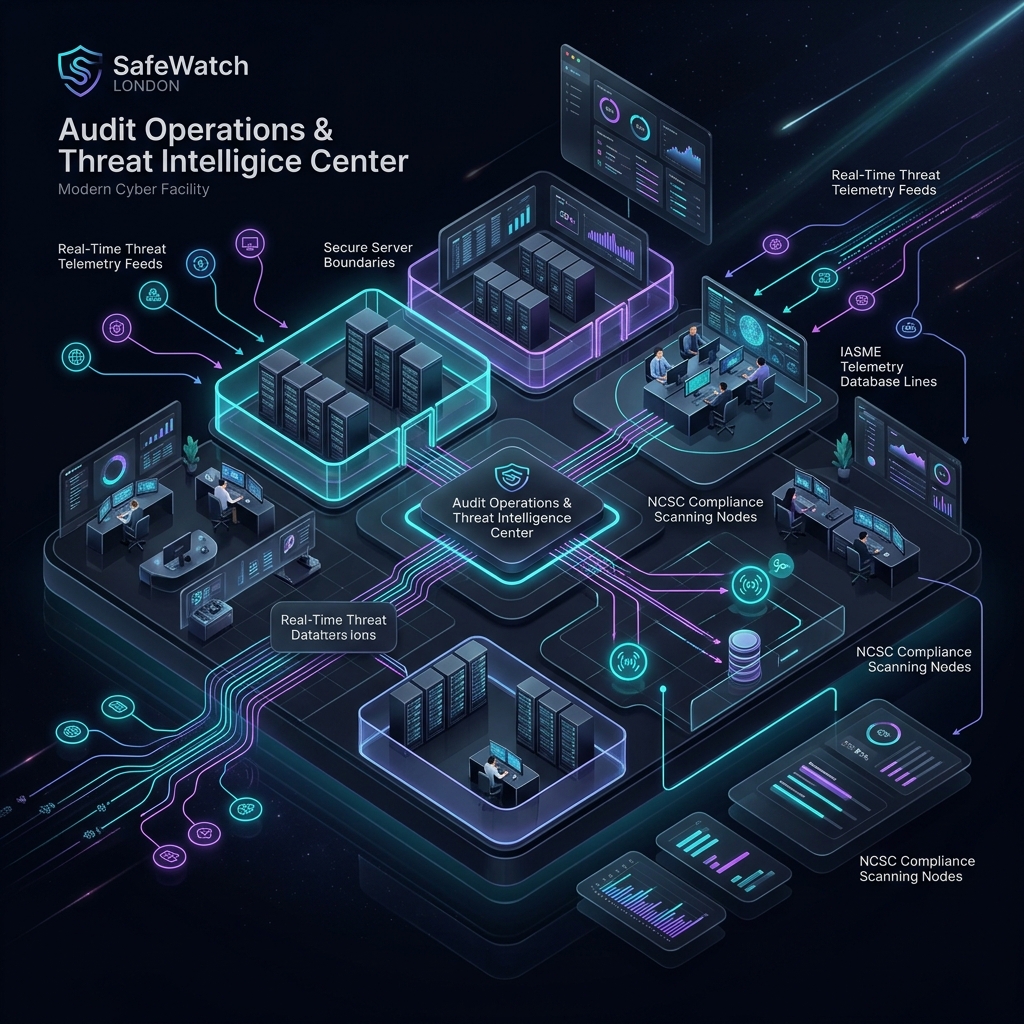
Key Corporate Benefits
- Tender Readiness: Qualify immediately for UK Crown Commercial framework bids.
- Insurance Discounts: Lower corporate cyber liability insurance premiums by proving technical controls.
- GDPR Safeguarding: Mitigate legal liability fines (up to 4% of global turnover) under the DPA.
FCA & Financial Advisory Cyber Security Compliance Checklist
UK Financial Conduct Authority (FCA) regulated firms, independent financial advisors (IFAs), fund managers, and solicitors operate under strict Senior Management Arrangements, Systems and Controls (SYSC) data security requirements. Achieving Cyber Essentials certification and securing the included £25,000 Cyber Liability Insurance policy satisfies core FCA operational resilience guidelines.
Enforce Multi-Factor Authentication across 100% of wealth management portals, cloud accounting tools, and advisor email logins under NCSC v3.3 rules.
FCA-regulated practices with turnover under £20M automatically receive £25,000 of commercial cyber policy coverage for data breach recovery and legal costs.
Eliminate zero-day vulnerabilities across advisor laptops and office servers by enforcing 14-day high/critical patch management routines.
Corporate Scoping Audit Reviews with Lead Assessor Team
Scoping corporate IT perimeters is notoriously complex. Defining guest Wi-Fi networks, remote work connections, and cloud tenants incorrectly will trigger automatic audit failures under the latest Cyber Essentials Standard framework. SafeWatch our Principal Lead Assessor personally reviews your estate scope to ensure 100% compliance alignment, delivering a stress-free certification pathway.
How an Open RDP Port Led to Manufacturing Shutdown
The Incident: A manufacturing enterprise in Warwickshire suffered a complete operational shutdown for six days following a ransomware infection. An attacker discovered a legacy server running Remote Desktop Protocol (RDP) exposed directly to the public internet on default port 3389, without a firewall constraint. The attacker compromised the server, moved laterally, and encrypted billing records, manufacturing control logs, and CAD templates, costing the firm £280,000 in recovery expenses and lost contracts.
How Cyber Essentials Would Have Prevented It:
- Boundary Firewalls & Internet Gateways: The framework strictly forbids exposing administrative services (like RDP, SSH, or SMB) directly to the open internet. Public-facing ports must be shut down or restricted behind a secure VPN.
- Secure Configuration & Default Protocol Hardening: Mandates disabling legacy protocols, closing non-essential ports, and enforcing custom admin profile criteria across all endpoints.
- Patch Management: Enforces updating all internet-facing perimeters and system firmware within 14 days of security vulnerability releases.
Cyber Essentials for Charities & Non-Profits across the Midlands
Protect donor financial transactions, safeguard sensitive beneficiary case files, and secure unmanaged volunteer personal devices from advanced social engineering.
Donor Trust, GDPR Compliance, and Information Asset Auditing
Charities are prime targets for cyber criminals because they handle high volumes of sensitive personal data (PII) and financial donations, often without full-time IT security staff. Under the UK General Data Protection Regulation (UK GDPR) and Data Protection Act (DPA 2018), trustees must enforce strict data boundaries and maintain an up-to-date Information Asset Register mapping all personal, donor, and beneficiary data. Achieving Cyber Essentials validates the technical perimeters guarding these critical assets, reassuring grant bodies and the public that funding and data are secure.
The Volunteer & BYOD Challenge
Securing a charity is uniquely complex due to a revolving, temporary volunteer workforce. Unlike employees, volunteers rarely undergo structured IT training, access cloud databases using unpatched personal laptops (BYOD), and lack centralized corporate accounts.
SafeWatch helps you configure lightweight Mobile Device Management (MDM) rules and session limits to isolate database access, securing your endpoints without compromising personal privacy.
Critical Cyber Hazards Targeting Charities
Criminals exploit the trust-oriented, high-activity non-profit sector:
Spear-Phishing & CEO Donation Scams
Phishing campaigns that mimic trustees or CEOs to trick finance coordinators into transferring charity program funding to overseas criminal accounts.
Exfiltration of Sensitive Beneficiary Records
Targeting vulnerable non-profit servers to steal confidential beneficiary files (health status, family records, housing) to blackmail families or sell data.
Donation Portal & Website Defacement
Hijacking website domains or injection of malicious code into online donation forms to skim credit card details directly from generous donors.

NCSC Charity Board Toolkit Scoping & Assessor Verification
Our Lead Assessor team works directly with charity trustees and boards to bridge the gap between compliance and mission safety. SafeWatch aligns your operational policies with the NCSC Charity Board Toolkit recommendations. We help you establish compliant boundary scopes, verify your UK GDPR Information Asset Register, audit cloud identity access (MFA), and align volunteer BYOD policies to ensure your charity secures compliance smoothly at fixed SME rates.
How Unpatched Volunteer Devices Lead to Data Breach
The Incident: A mid-sized UK support charity suffered a major data breach when an attacker compromised a volunteer’s unpatched personal tablet (BYOD) via a simple phishing email. The attacker extracted cached administrative login credentials for the charity's main cloud case-management database, which lacked Multi-Factor Authentication (MFA). This resulted in the theft of 1,200 sensitive beneficiary case files and a mandatory reporting fine under UK GDPR/DPA rules.
How Cyber Essentials Would Have Prevented It:
- Multi-Factor Authentication (MFA): Stolen cached credentials alone would be useless without a second factor, blocking access to the cloud database.
- Patch Management & System Updates: Cyber Essentials forbids any device running unsupported or unpatched software from accessing organizational systems. Automatic updates on the volunteer's tablet would have blocked the initial browser exploit vector.
- Secure Configuration & Scope Isolation: Restricting user accounts to local standard profiles rather than administrative privileges limits the damage from compromised BYOD credentials.
Cyber Security Audit for Academy Trusts, Schools & Multi-Academy Trusts (MATs)
Satisfy Department for Education (DfE) Cyber Security Standards and ESFA funding mandates. SafeWatch delivers official IASME Cyber Essentials & Cyber Essentials Plus cyber security audits, gap analysis, and penetration testing for Multi-Academy Trusts (MATs), primary/secondary schools, and further education colleges across Oxfordshire, Warwickshire, and UK-wide.
Download 2026 School & Academy Trust Pre-Audit Checklist PDF
Step-by-step Cyber Essentials audit preparation checklist for UK schools, colleges, and Multi-Academy Trusts (MATs). Verify safeguarding databases, staff MFA, and student BYOD networks.
Cyber Essentials in Education: Satisfying UK DfE Standards
The UK Department for Education (DfE) has issued mandatory Cyber Security Standards for all schools, colleges, and academy trusts. Proving compliance with Cyber Essentials in Education is a critical requirement for securing school budgets and academy capital grants. Cyber Essentials is the official government-backed framework specified to demonstrate that classroom networks, staff HR systems, and student records are defended against hostile actors.
Critical Cyber Risks Facing Educational Institutions
Schools run dense, high-traffic networks exposing multiple entrance vectors:
Ransomware Targeting Exam & Term Operations
Encrypting central student management portals, safeguarding logs, and exam files, intentionally timed to block enrollment weeks or exams to maximize pressure.
Safeguarding & Student PII Leaks
Breaches targeting highly confidential student safeguarding databases and special educational needs (SEN) logs, resulting in severe child safety and regulatory risks.
Classroom BYOD & Open Network Hijacking
Students and staff bringing thousands of unmanaged personal Chromebooks, iPads, and smartphones onto the school Wi-Fi, introducing malware to the LAN.

Safeguarding Value
- DfE Compliant: Satisfy mandatory standards to secure capital allocations and funding streams.
- Student Shielding: Protect sensitive safeguarding logs and medical files.
- Network Hardening: Secure Wi-Fi subnets used by students and teachers.
Multi-Academy Scoping & Auditing by our Lead Assessor team
Multi-Academy Trusts (MATs) and schools maintain highly complex boundaries with distributed campuses, staff working from home, and hundreds of public-use Chromebooks. Defining what is in-scope under the Danzell standard requires specialized assessment. our accredited Lead Assessor team helps schools segment student networks from administrative subnets, ensuring your admin system achieves certification smoothly while minimizing operational disruptions.
How Compromised Staff Credentials Closed a Secondary Academy
The Incident: A secondary school academy trust in the Midlands suffered a devastating ransomware attack on the first week of the autumn term, encrypting classroom registers, medical logs, SEN data, and lesson servers. The attacker compromised a teacher's remote-access VPN credentials via a credential-stuffing attack on a home computer that lacked Multi-Factor Authentication (MFA). Once inside, the attacker traversed the flat network, infecting the main administrative subnet. The trust was closed for four days, incurring £80,000 in recovery costs and severe reputational damage.
How Cyber Essentials Would Have Prevented It:
- Multi-Factor Authentication (MFA): Stolen password credentials would be rendered useless without the secondary physical factor authentication code, blocking initial access.
- Network Segmentation & Subnet Boundaries: Cyber Essentials requires separating high-risk networks (such as open pupil Wi-Fi or classroom labs) from the core administrative system containing student records and financial systems.
- Supported Operating Systems & Patching: Limits external VPN connections to authorized, updated endpoints, blocking known vulnerabilities on unmanaged home computers.
Mapping Cyber Essentials to the DfE Cyber Security Standards
The UK Department for Education (DfE) expects all academies and schools to meet their official Cyber Security Standards. Obtaining a Cyber Essentials certification is the primary, government-recommended method to prove compliance. Below is how our assessment maps to the core DfE directives:
Firewall Protection (Standard 1)
Every device connected to your school network must be protected by a properly configured boundary firewall to filter hostile incoming traffic.
Secure Accounts & Access (Standard 2)
Administrator privileges must be strictly controlled, standard staff accounts must use MFA, and default device passwords must be changed.
Device & Anti-Malware (Standard 3)
All classroom PCs, iPads, and teacher laptops must run active antivirus software that updates signatures daily and restricts untrusted apps.
Patch & Lifecycle Management (Standard 4)
Critical software updates must be installed within 14 days of release, and all unsupported, End-of-Life (EOL) operating systems must be removed.
Information Security Awareness Training
Foster a resilient security culture across your organization. SafeWatch provides targeted training programs tailored to different business roles, ensuring alignment with NCSC standards and security policies.
Frontline Cyber Security Hygiene
Your employees are your first line of defense. This curriculum focuses on building practical, day-to-day security habits that protect company assets and mitigate common social engineering risks.
- Social Engineering & Phishing: Recognize sophisticated email, SMS, and phone phishing attempts.
- Strong Password Hygiene: Establish rules for unique passphrases and secure password managers.
- Remote Work & Wi-Fi Safety: Secure home networks, utilize VPNs, and handle public Wi-Fi risks.
- BYOD & Device Security: Maintain strict boundary guidelines on personal devices used for work.
Governance, Scoping & Risk
Designed for C-level executives and board members to understand security from a strategic, legal, and financial perspective.
- NCSC Board Toolkit: Align security metrics with core business governance.
- GDPR & Compliance: Understand regulatory liabilities and corporate data protection duties.
- Cyber Essentials ROI: Scoping auditing bounds to maximize insurance premiums and tender access.
Policy Enforcement & Access
Equip middle management with the tools to implement, monitor, and enforce security policies within their respective teams.
- Least Privilege Access: Administer user accounts to prevent unauthorized access permissions.
- Incident Escalation: Lead incident response procedures when alerts or breaches occur.
- Onboarding Protocols: Enforce mandatory security setup steps (MFA, updates) for new hires.
SafeWatch Accredited Compliance Training Pathway
Our structured training curriculum guides teams from fundamental security awareness to technical readiness for the NCSC Cyber Essentials audit.
Book Information Security Readiness Training
Submit your training requirements below. Your inquiry will be sent directly to hello@safe-watch.co.uk for Lead Assessor review and date scheduling.
Cyber Essentials Gap Analysis & Audit Questionnaire Diagnostic
Perform a free Cyber Essentials gap analysis to evaluate your organization's compliance against the 5 core NCSC technical controls—identifying firewall rules, MFA gaps, and patch management SLAs prior to official audit submission.
1. Scoping Personalisation
Provide your organization's scope parameters to customize the diagnostic metrics, DPA/GDPR compliance formulas, and exportable board reports under the latest Cyber Essentials Standard.
Need Help With This Question?
Cyber security terminology can be confusing! Speak directly with our accredited Lead Assessor desk or a senior auditor on our accredited IASME team.
Direct line to Accredited Lead Assessor Desk & Accredited Assessor Desk
Callback Request Submitted!
Thank you! One of our experienced assessors will call you back shortly at your provided phone number.
Contact SafeWatch Banbury | Official IASME Certifying Body
IASME Certifying Body headquartered in Banbury, Oxfordshire. Speak directly with Lead Assessor Steven Gordon (07920 151412) for Cyber Essentials audits & quotes.
Steven Gordon — Lead Assessor Desk
Licensed IASME Cyber Essentials Auditor | Banbury Desk: 07920 151412 • Mon-Fri 08:30-17:30
Direct Contact Channels
Connect directly with our auditing team in the Midlands for rapid response times.
Call Our Desk
Email Inquiries
Local Office
Banbury, Oxfordshire, United Kingdom
Availability Hours
Monday - Friday: 08:30 - 17:30 GMT
Auditing Team
Steven Gordon
Lead Assessor
Markus Backman
Accredited IASME Assessor
Send a Message
Message Transmitted Successfully
Thank you. Lead Assessor Steven Gordon or a member of our auditing team will review your query and contact you within 24 operational hours.
Request Cyber Essentials Certification
Input your operational metrics. SafeWatch’s smart inquiry portal recommends the ideal pathway and prepares customized engagement scopes in real-time.
Accredited Engagement Inquiry
Recommended Audit Scope
Empowering Human Expertise Through AI Innovation
At SafeWatch, we are unapologetically pro-AI. We embrace modern artificial intelligence and autonomous agentic workflows as transformational tools that allow humans to focus on what humans do best: strategic judgment, critical reasoning, and authentic personal relationships.
AI Search Indexing & llms.txt Standard Integration
SafeWatch is fully optimized for AI Search Assistants (Google Gemini, ChatGPT, Perplexity, Claude, Apple Intelligence). We publish a public /llms.txt site summary specification and open RAG schemas for AI search engines.
The Four Pillars of Our AI Ethos
Human-Centric Mastery
Technology should elevate human capability, not diminish it. We assign AI to do heavy data lifting and initial code scaffolding, freeing our lead assessors to dedicate maximum time to high-value client advisory, scoping clarity, and direct communication.
Delegate, Don't Abdicate
We never blindly accept automated AI outputs. Every policy document, scoping guide, and vulnerability assessment rule undergoes rigorous human review. We take full ownership of every word and line of code published on our domain.
Open Community Sharing
We do not sell AI consulting as a proprietary product. Instead, we engage openly as active members of the UK IT community to share lessons learned, prompt workflows, and practical agent integrations with fellow IT leaders and partners.
AI Governance & Compliance
Integrating AI tools into your business operations must be done safely. We help organizations understand how AI usage intersects with NCSC Cyber Essentials controls—ensuring data privacy, preventing shadow IT, and maintaining strict patch SLAs.
How AI Intersects With Cyber Essentials Compliance
As organizations rapidly adopt generative AI, Copilots, and autonomous agents, maintaining compliance under the 5 NCSC controls requires proactive governance:
Prevent unauthorized data leaks by ensuring internal corporate documents and PII are not ingested into public LLM training datasets.
Apply Least Privilege rules to AI agent API keys and integration tokens, restricting access to sensitive databases and administrative APIs.
Maintain 14-day security patch cycles for local AI runtimes, open-source model frameworks (such as Ollama or PyTorch), and browser extensions.
Let's Talk AI & Cyber Security
Interested in discussing how we leverage AI tools in our workflow, or want to ensure your organization’s AI adoption remains compliant with Cyber Essentials? our Lead Assessor team is always happy to connect with fellow IT leaders.
Cyber Essentials Plus Audits & Technical Verification
Hands-on technical verification, internal vulnerability scanning, and email/web defense testing conducted by our accredited Lead Assessor team.
Independent Technical Audit & Hands-On Testing
While standard Cyber Essentials is a verified self-assessment, Cyber Essentials Plus is the highest tier of government-backed accreditation. It includes an independent, hands-on technical audit conducted by our accredited Lead Assessor team to verify that the technical controls declared in your self-assessment are functioning correctly across your estate.
Our assessors test sample endpoints (workstations, laptops, cloud servers, mobile devices) against external vulnerability scans, internal network scans, email attachment security, and web browser payload execution.
Why Upgrade to Plus?
- Government Tenders: Mandatory for PPN 09/14, MOD DEFCON 658, and central government contracts.
- NHS Compliance: Satisfies NHS Digital Data Security and Protection Toolkit (DSPT) requirements.
- Supply Chain Trust: Proves to enterprise partners that your defenses have undergone independent technical testing.
How SafeWatch Conducts the Cyber Essentials Plus Audit
Our accredited assessors execute four mandatory technical testing modules as specified under the official NCSC audit criteria:
We run vulnerability port scans against all public IP addresses and perimeter gateways declared in scope, verifying that open admin ports or unpatched vulnerabilities are absent.
We scan a representative sample of workstations, servers, and mobile devices to verify that operating systems and high-risk software (browsers, Office, Acrobat) are patched within 14 days.
We send benign test files (such as executable attachments and macro-enabled documents) via email and web downloads to verify that your endpoint security blocks execution.
We audit sample user accounts to ensure standard day-to-day web browsing and email tasks are conducted without administrative privileges, enforcing Least Privilege access.
Ready to Schedule Your Cyber Essentials Plus Audit?
Speak directly with our Lead Assessor desk to define your sample endpoint scope, run pre-audit vulnerability checks, and book your technical audit window.
Free £25,000 UK Business Cyber Liability Insurance
UK-domiciled organizations with turnover under £20 million automatically receive £25,000 of free cyber insurance coverage upon achieving Cyber Essentials through SafeWatch.
Automatic £25,000 Cyber Protection for UK SMEs
Achieving NCSC Cyber Essentials certification demonstrates that your organization has implemented basic technical security hygiene. To further safeguard UK small and medium enterprises, the IASME Consortium includes £25,000 of commercial cyber liability insurance automatically with every valid Cyber Essentials certificate issued to qualifying UK businesses.
The policy runs for 12 months alongside your Cyber Essentials certificate validity and provides 24/7 emergency incident response helpline support in the event of a suspected cyber breach or ransomware incident.
Who Qualifies for Free Coverage?
- UK Domiciled: Organization must be headquartered or domiciled in the United Kingdom.
- Turnover Limit: Annual turnover under £20 Million.
- Certification: Certified by an accredited IASME Certifying Body (like SafeWatch).
- Opt-In: Opted in during questionnaire sign-off.
Key Insurance Policy Protections Included
The £25,000 IASME cyber liability policy provides comprehensive financial and technical support during a security incident:
Covers specialist technical IT forensic investigators to identify breach sources, contain active malware, and secure your network perimeter.
Pays for IT technician hours to restore damaged databases, re-install operating systems, and reconstruct corrupted business data from backups.
Provides financial relief for net operational income lost during a severe cyber outage or ransomware downtime event.
Includes legal defense representation for data breach notifications, ICO regulatory support, and ransomware extortion incident resolution.
Get Cyber Essentials Certified & Claim Your Free £25k Policy
Working directly with SafeWatch ensures zero hidden reseller fees, fast 24–48 hour turnaround options, and instant policy issuance upon passing.
Cyber Security & Compliance Articles
Explore real-world case studies, regulatory supply chain mandates, and empirical data demonstrating how NCSC Cyber Essentials reduces cyber incident exposure across UK organizations.
St. James’s Place Mandates Cyber Essentials Across 2,800+ Partner Practices
How UK wealth giant St. James’s Place (£170B AUM) achieved an 80% reduction in cyber security incidents by enforcing NCSC baseline controls across 2,800+ partner advisory firms.
Anatomy of Telecom & Banking Cyber Outages in Angola
Technical breakdown of the Unitel IPO cyber attack and Central Bank breaches, highlighting how unpatched edge routers and missing MFA crippled nationwide SMS 2FA and banking.
NCSC Warning: State-Sponsored Targeting of SME Perimeter Routers
Technical advisory detailing threat actor exploitation of unpatched office firewalls and VPN gateways, and how Cyber Essentials Control #1 and #5 block 80%+ of attack vectors.
Cyber Essentials Proven to Reduce Cyber Incidents by Up to 99%
Government and NCSC telemetry confirms that enforcing boundary firewalls, MFA, secure configurations, malware defense, and 14-day patching blocks up to 99% of commodity cyber attacks.
Securing Non-Profits & Community Hubs With Cyber Essentials
How non-profit organizations work alongside our Lead Assessor desk to audit perimeters, enforce MFA on booking portals, and secure £25,000 in free cyber insurance cover.
PPN 09/14: Why Cyber Essentials is Required for Public Sector Tenders
A breakdown of Cabinet Office Procurement Policy Note PPN 09/14 and why defense, healthcare, and public sector contractors must hold valid Cyber Essentials verification.
Cyber Security Audits & Pentesting for Academy Trusts & Schools
Learn how Multi-Academy Trusts (MATs) and UK schools satisfy Department for Education (DfE) Cyber Security Standards and ESFA funding mandates through accredited audits.
Why 365-Day Continuous Compliance Beats Annual Point-in-Time Audits
Why forward-thinking UK CISOs are shifting from stressful annual audit rushes to continuous compliance retainers featuring 4 quarterly reviews and year-round assessor access.
Cyber Essentials for SMEs in Banbury, Bicester, Warwick & Oxford
How regional businesses across Cherwell, Warwickshire, and Oxfordshire protect commercial livelihoods and satisfy supply chain requirements with direct Lead Assessor guidance.
Ready to Secure Your Organization or Supply Chain?
Whether you are an independent practice, a growing SME, or an enterprise managing hundreds of suppliers, SafeWatch makes Cyber Essentials simple and stress-free.
Privacy Policy & GDPR Statement
This statement details how SafeWatch Midlands processes, secures, and retains client data in full compliance with UK GDPR and NCSC Cyber Essentials auditing mandates.
1. Introduction & Data Controller
SafeWatch Midlands is committed to protecting the privacy of our clients and website visitors. For the purposes of the UK General Data Protection Regulation (UK GDPR) and the Data Protection Act 2018, the Data Controller is SafeWatch Lead Assessor Desk, residing at Banbury, Oxfordshire (Email: hello@safe-watch.co.uk).
2. Information We Collect
We collect and process the following information when you interact with our website or book an audit:
- Contact Information: Your name, organization name, phone number, email address, and physical address.
- Auditing & Scoping Data: Scope metrics, user counts, network details, and compliance declarations submitted via forms, gap diagnostic tools, or scope calculators.
- Technical Metadata: IP address, device type, browser information, and referral URLs gathered via web logging.
3. Lawful Basis and Purpose of Processing
We process data under the following lawful bases:
- Contractual Obligation: To prepare scoping proposals, quote prices, schedule audits, verify questionnaire responses, and process official Cyber Essentials / Plus certifications.
- Legitimate Interests: To operate our gap diagnostics, run awareness modules, address queries, and safeguard website perimeters.
- Legal Compliance: To maintain official certification records as strictly required by NCSC and IASME auditing standards.
4. Third-Party Data Sharing
As an accredited Certifying Body, your organization name, registration details, and certification status are securely transmitted to IASME Consortium Ltd (the scheme partner) and the National Cyber Security Centre (NCSC) to issue certificates and publish your status on the official UK Compliant Register. We do not sell or lease your personal information to unrelated third-party marketers.
5. Data Retention & Security
Official assessment forms, scanning logs, and audit credentials are archived securely for a minimum of 3 years as mandated by the IASME Certification Body Agreement. Website contact submissions and temporary diagnostic responses are purged within 12 months if they do not lead to an active contract. All data is stored in encrypted databases with active Multi-Factor Authentication (MFA) and perimeter firewall controls.
6. Your Rights under UK GDPR
Under UK data protection laws, you hold statutory rights including:
- The right to access your stored data and verify scoping histories.
- The right to rectify inaccurate records or complete scoping sheets.
- The right to erasure ("right to be forgotten"), subject to statutory audit retention mandates defined by IASME.
- The right to lodge a complaint with the Information Commissioner's Office (ICO) if you believe we have breached your rights.
Complaints & Appeals Procedure
Official policies for Accredited IASME Certification Bodies, detailing conflict of interest mitigation, complaints escalation, and audit appeals.
1. Overview of Complaints & Appeals
SafeWatch Midlands is committed to delivering professional, objective, and accurate auditing services. In compliance with IASME licensing standards, we maintain a transparent, structured pathway for clients wishing to lodge service complaints or appeal a "Fail" result issued during a Cyber Essentials assessment.
2. How to Lodge a Complaint or Appeal
All complaints or appeals must be submitted in writing within 14 calendar days of the event or certification decision. Submissions must be emailed directly to our accredited Lead Assessor team at hello@safe-watch.co.uk and contain:
- Organization Name and Primary Contact details.
- Date of assessment and target scope details.
- Specific details of the dispute or technical grounds for appealing a failed control checklist.
3. Investigation and Resolution Window
Upon receipt of a written appeal or complaint, SafeWatch initiates the following process:
- Acknowledgement: Receipt will be acknowledged in writing within 3 business days.
- Independent Review: All raw questionnaire files, scoping bounds, and endpoint scan outputs will be re-evaluated against the NCSC core requirements.
- Formal Verdict: A comprehensive written determination outlining the findings and resolution will be issued within 10 business days.
4. Escalation to IASME
If the outcome of our review does not resolve the dispute to your satisfaction, you have the right to escalate your appeal directly to the licensing authority: The IASME Consortium. Their independent adjudication team will review our auditing records and issue a final ruling. Information on contacting IASME can be found at https://iasme.co.uk.
5. Segregation of Consultancy and Assessment Roles
Under the IASME Certifying Body Code of Conduct, SafeWatch maintains strict operational segregation. Our lead assessors are prohibited from auditing and signing off on any systems, configurations, or networks where they have personally designed, built, or implemented the primary security controls, unless an independent, accredited peer assessor conducts a secondary validation.
Global Cyber Threat Monitor
2026 NCSC Cyber Threat Matrix & Advisory Bulletin
Cross-referenced against UK NCSC Threat Intelligence feeds. Implementing Cyber Essentials 5 Controls blocks >80% of automated cyber attacks.
Protect Your Business Against Active Vulnerabilities
Active vulnerabilities require swift mitigation. Check if your current configurations align with the official NCSC standard using our Gap Diagnostic tool.
Cyber Essentials Frequently Asked Questions
Direct answers from our accredited Lead Assessor team on turnaround times, pricing, free cyber insurance, and tender compliance.